Florals look effortless right up until you press cut. Then the stem that gave the design its whole shape tears out of the vinyl during weeding, or the petals come off the laser bed sliced into fragments because every overlap cut as its own outline. Nothing about the artwork was wrong. It just was not drawn to be made.
That gap between a pretty floral graphic and a floral cut file is the whole subject here, along with the projects that pay off once you are on the right side of it: wreath signs, monogram surrounds, botanical line art panels, and pressed-flower style pieces for the wall.
Tip
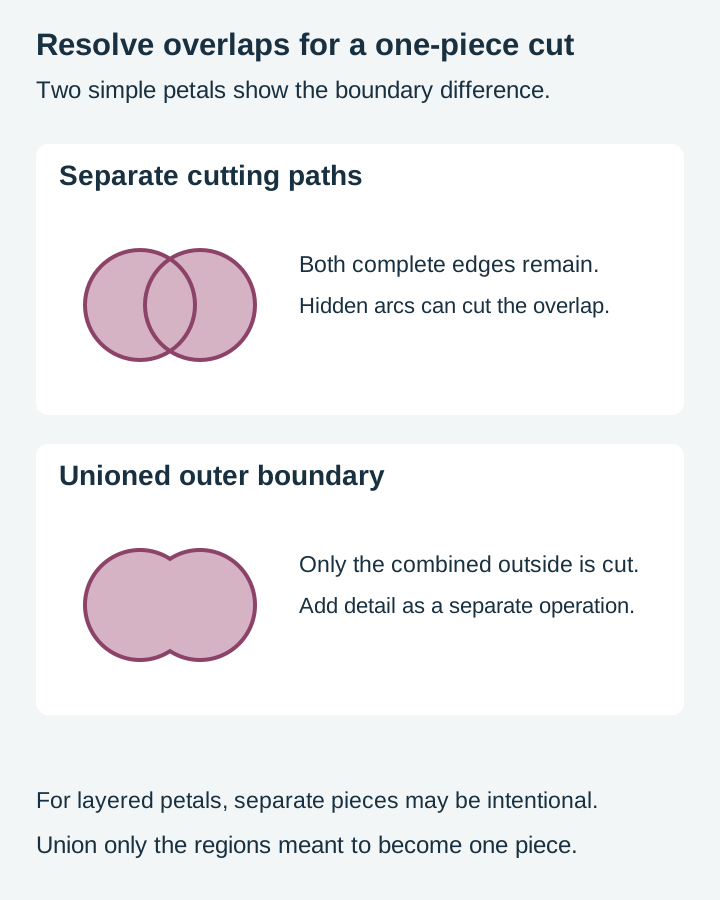
The short version: florals fail at two places, the thinnest stem and the petal overlaps. Check that the narrowest element is wider than whatever your material or bit can hold, and that cut boundaries are intentional. A single-piece flower needs overlaps resolved, while a layered flower can use separate petals.
The two things that break a floral design
Thin stems. A stem is the most fragile thing in botanical artwork, and it is fragile in a different way on every machine. Fine adhesive-vinyl stems can stretch during weeding and transfer; there is no universal two-millimeter cutoff. A narrow plywood stem can snap during handling. A 3mm end mill cannot enter a 2mm internal gap, but it can leave a 2mm external stem if there is tool access on both sides and the material can support it.
The way around it is not always to thicken the stem. Often it is to support it. A stem that runs into a leaf, a ribbon, or the frame at both ends is braced, and it can stay visually delicate because it is no longer carrying itself. That is a drawing decision, made before the file ever reaches you, and it is the main difference between a floral pack built for cutting and a floral clipart set.
Overlapping petals. Draw a rose the natural way and each petal is its own closed shape, layered over its neighbors. On screen the hidden edges disappear behind whatever sits on top. A cutter has no concept of "behind". It follows every path it is given, so those buried edges get cut too, and the flower arrives as a heap of petal fragments with the outline traced two or three times over.
The fix is to resolve the flower into a single cuttable boundary, then decide deliberately which interior lines earn their place. Kept lines go on an engrave layer or become genuine cut-through gaps between petals. That resolution step is invisible when it has been done well, which is exactly why people assume it does not need doing.
Floating pieces are the third trap, and the sneakiest, because it costs nothing when you engrave. A wreath with detached berries and a few unattached leaves engraves beautifully. Transfer tape can preserve separate vinyl elements, and a solid backer can support separate wood pieces. A freestanding one-piece cutout needs every retained element connected, the same principle behind bridges and tabs in stencils.
Wreath signs and the empty middle
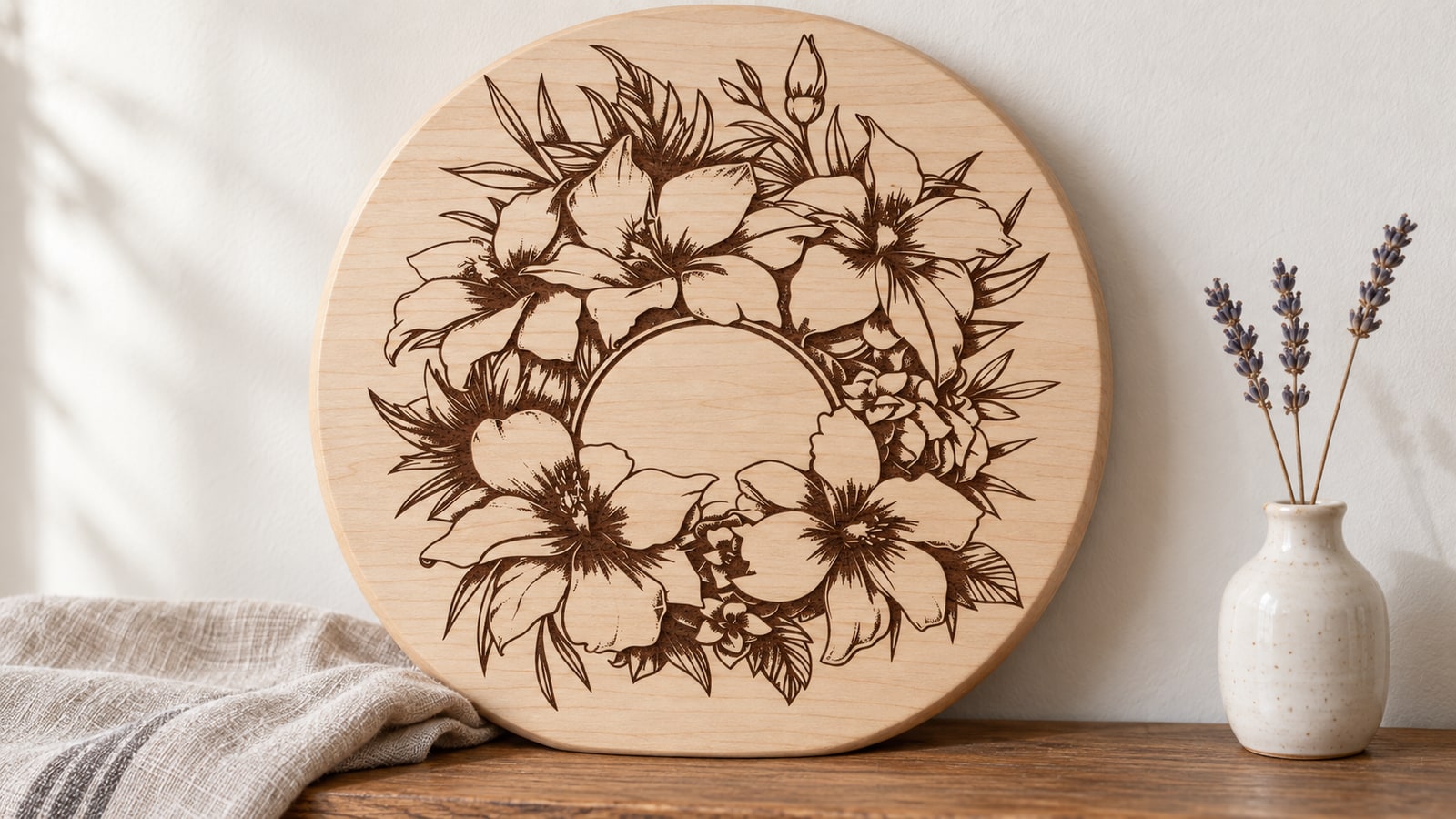
The single most reliable floral project is a wreath or a bouquet with an open center reserved for a name, a date, or a family word. It works because the buyer is paying for the personalization and the florals are the frame around it.
The design side of that is mostly restraint. A wreath needs a genuinely empty field in the middle, sized for text at the largest length a name might reach, not the shortest. Fill the whole circle with foliage and every order becomes a negotiation about where the lettering will fit.
Our Floral Signs Part 1 pack is drawn on that assumption. Its 43 designs are largely bouquets, corner sprays, and banner arrangements with the banner left blank, so you drop in the name and cut. Hibiscus and tropical leaf arrangements sit alongside dahlias and roses in the same pack, which matters more than it sounds: a customer ordering three signs usually wants them to look related.
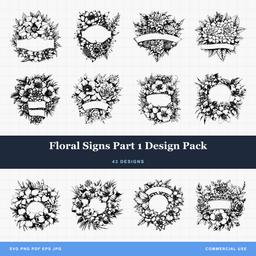 Floral Signs Part 1 Design Pack43 designs, commercial license included$3.99
Corner sprays deserve a mention of their own. A pair of them, one top left and one bottom right, frames a sign with a fraction of the engraving time of a full wreath, and it is the cheapest way to make a plain rectangular blank look designed.
Monogram surrounds
A letter inside a floral ring is one of those combinations that has never gone out of fashion, and it suits every machine on this list. Engraved on a wood round it is a housewarming gift. Cut from vinyl it is a door decal. V-carved on a hardwood panel it is a wedding present that outlives the wedding.
The classic treatment is the split monogram, where a decorated letter is flanked by the family name running through the gap. Our Split Monogram Designs pack has 50 of them, and they pair with almost any floral border because the letter is already drawn to sit inside something.
One caution when you cut rather than engrave a monogram surround: the letter and the ring have to be joined, or you get a floating letter and a loose ring. Connect the letter to the ring with adequate bridges, mount both on an intact backing, or engrave the design on a solid panel. Both are fine. Discovering it halfway through a paid order is not.
Botanical line art, which is a different animal
Line art florals, the single-weight outline style, have taken over modern decor, and they behave differently from filled silhouettes.
Line art wants to be engraved or drawn, not cut. A centerline stroke does not automatically become a band of cuttable material. Convert a visible stroke to closed geometry if you want its width cut, and inspect the imported fill. An open centerline can be scored; a closed centerline may still enclose a fill region depending on the software. Artwork that has to cut must be built from closed filled shapes, and the symptom when it is not is a design that refuses to fill or cuts as a single hairline. Our post on open paths and why a design refuses to cut covers the diagnosis in detail.
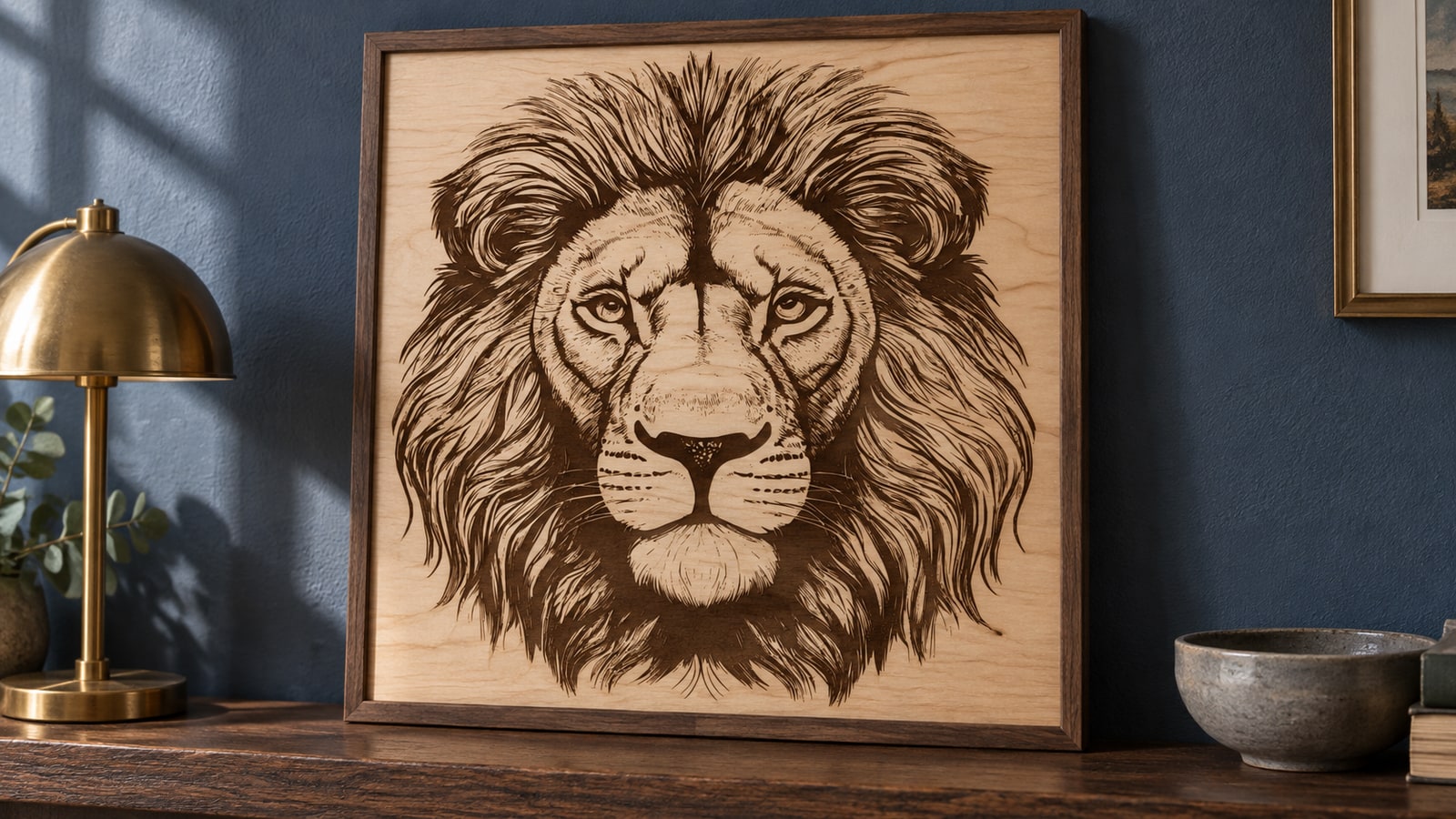
Where line art shines is on a laser as a fine engrave on maple or birch, on a pen plotter for stationery, and, after converting strokes to suitable closed shapes, as a single-color vinyl decal for glass, where the sparse look is the point. Three tall stems on a bathroom mirror is a fifteen-minute job that looks like a boutique bought it.
Pressed flower style pieces
The pressed-flower look, flat botanical specimens arranged as though they came out of a herbarium, translates surprisingly well to a machine because the source material was already flat.
Two approaches work. Engrave the specimens onto a wood or acrylic panel and frame it, which gives you the museum plate effect in one pass. Or cut each botanical from cardstock or thin veneer and mount them with spacers in a shadow box, which gives real physical depth and looks considerably more expensive than it costs. The layered version borrows its technique from layered multi-color vinyl work, so if you have done that before, you already know the alignment routine.
For the cut version, choose specimens with fat leaves and simple stems. Wispy grasses and fern fronds are the ones that look best on screen and disintegrate in the hand.
Birth month flowers, and why they sell
Birth flowers are the personalization idea that has quietly overtaken zodiac signs. Every person has one, nobody has to know their own for it to feel meaningful, and a set of them tells a family story in one panel: a mother's plaque carrying her children's flowers, or a couple's anniversary sign with two blooms crossed.
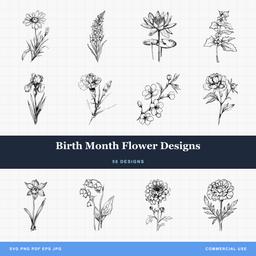 Birth Month Flower Designs50 designs, commercial license included$3.99
The 50 designs in that pack cover the months in both drawing styles, detailed line art versions and cut-ready silhouettes of the same flower. That pairing is the useful part. The silhouette carnation is what you cut from vinyl or plywood, and the line art carnation is what you engrave on the same job, so a matched set across mixed materials still looks like a set.
Matching the design to the process
The starting points below come from how these files are drawn rather than from machine testing, since the limits are set by the geometry in the file and by your material. Treat them as a place to begin and cut one before you cut fifty.
| Process | Best floral style | Watch the |
|---|---|---|
| Laser engrave on wood | Line art, detailed botanicals | Resolution, interval, contrast and wood grain |
| Laser cut plywood | Bold silhouettes, connected wreaths | Stems, and any element not joined to the body |
| Vinyl and HTV | Simple silhouettes, corner sprays | Narrow stems, tiny leaves, floating berries |
| CNC V-carve | Wreaths and monogram surrounds | Bit angle, target depth and clearance for flat-bottom tools |
| CNC relief | Sculpted botanical medallions | Depth model rather than an outline |
| Glass etch or decal | Sparse line art, single stems | Keeping it sparse, density kills the look |
Relief is the outlier on that list because it is not an outline at all. A botanical relief medallion carries height information, so the petals actually rise off the surface instead of being suggested by a line. Our Botanical Relief Medallions pack has 46 of those covering flowers, herbs, fruiting branches, ferns, and succulents.
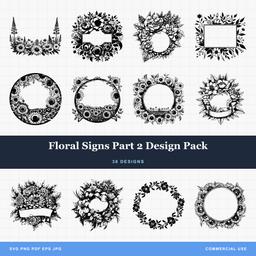 Floral Signs Part 2 Design Pack38 designs, commercial license included$3.99
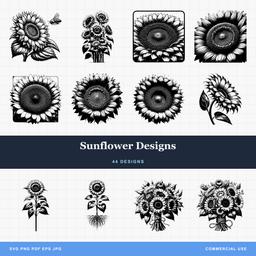 Sunflower Designs44 designs, commercial license included$3.99
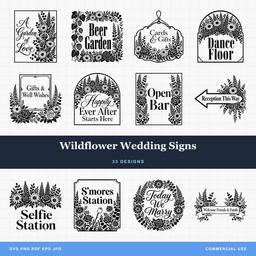 Wildflower Wedding Signs33 designs, commercial license included$3.99
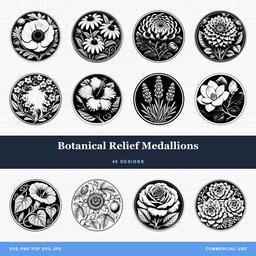 Botanical Relief Medallions46 designs, commercial license included$3.99
If you need to fix a stem yourself
Sometimes you buy a design elsewhere, or draw your own, and the stem is simply too thin for the material you have. That is node work, not a redraw. NodeCraft on Craftgineer, our sister site, is a browser vector editor with real node and path editing, and it is free to use and export with a free account. Saving a project to come back to later needs a paid plan, which starts at $4.99 a month. Inkscape does the same job on the desktop if you would rather work offline.
Where to start
Florals carry more of our catalog than any other single style, and they cross categories: the sign packs and birth flowers sit in Nature & Outdoors, while monograms, garden flags, and wildflower wedding signs live in Quotes & Text. If weddings are your market specifically, our 15 wedding project ideas picks up where this leaves off.
Every pack is $3.99, ships as SVG, PNG, JPG, PDF, and EPS, and includes a commercial license with no cap on the finished pieces you sell, print-on-demand included. Start with Floral Signs Part 1 if you are making signs, or Birth Month Flower Designs if personalization is what your customers keep asking for.
Designs for this project
Floral Signs Part 1 Design Pack43 designs, commercial license included$3.99Birth Month Flower Designs50 designs, commercial license included$3.99Floral Signs Part 2 Design Pack38 designs, commercial license included$3.99Sunflower Designs44 designs, commercial license included$3.99Wildflower Wedding Signs33 designs, commercial license included$3.99Botanical Relief Medallions46 designs, commercial license included$3.99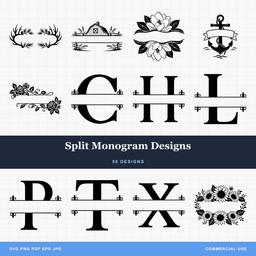 Split Monogram Designs50 designs, commercial license included$3.99
Frequently Asked Questions
How thin can a flower stem be in a cut file?
It depends on what the stem is made of once it leaves the machine, not on how it looks on screen. Fine vinyl stems can stretch during handling and narrow wood stems can break. A router can leave an external stem narrower than the bit, but cannot enter an internal channel narrower than its cutting diameter. Test the actual geometry and material. Engraving is the exception, because an engraved stem is a mark rather than a structure and can go as fine as your machine resolves.
Why does my floral design cut as double outlines?
Because the petals are still separate overlapping shapes and the cutter is following every edge, including the ones hidden behind other petals. For a one-piece cutout, merge the intended overlapping regions and move decorative interior lines to an engraving operation. Layered petals or stroked outlines may require a different preparation. Files drawn as cut-ready silhouettes have that work already done.