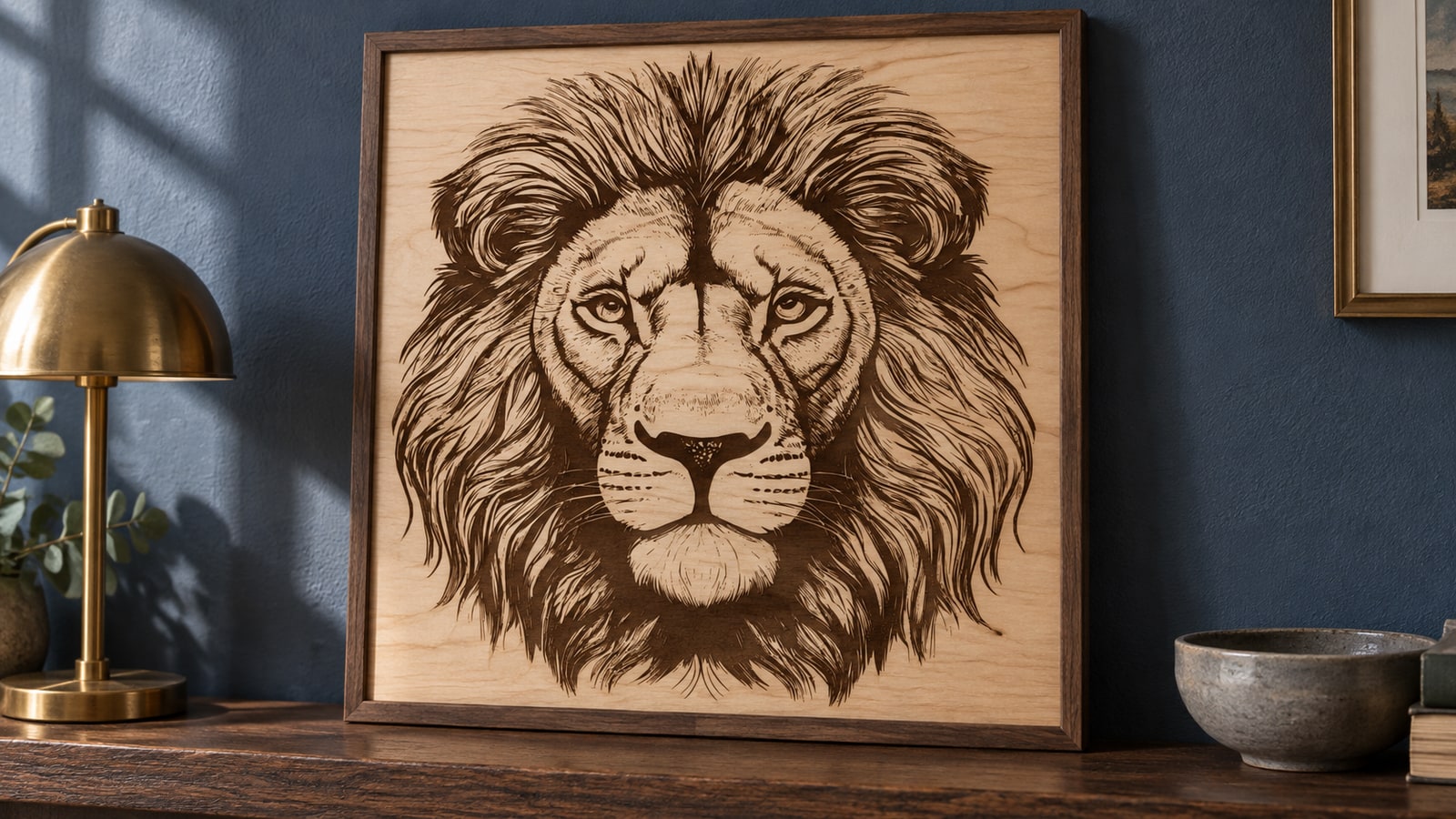
There is a difference between filling a wall and owning it. Most animal cut files are gentle: a deer, a hummingbird, something nice above a hallway table. Then somebody wants the piece over the fireplace to be the first thing anyone sees when they walk in, and a big cat is the obvious answer. A lion staring straight out of a walnut panel is not decor you politely ignore.
The catch is that the exact thing making these animals dramatic, which is the coat, is the thing that decides whether the file cuts as one solid object or comes off the bed in pieces. A tiger carries more stripes than you can count by eye. A jaguar carries dozens of rosettes with spots inside them. Every one of those markings is a decision the file already made for you, and it is worth knowing which decision before you commit a good board to it.
(If you arrived looking for house cats, breeds and funny sayings, that is a different post: cat SVG designs for breeds and sayings. This one is about the wild ones and the big pieces they suit.)
Three cats, three completely different files
Lions, tigers and jaguars get grouped together because they are all big cats, but from a file point of view they have almost nothing in common. One is a detail problem, one is a stripe problem, and one is a nesting problem.
The pairings below are a design-side starting point drawn from how we build the files rather than something measured on a machine, so treat them as a place to begin and test on your own material.
| Cat | What the file is really made of | Best process |
|---|---|---|
| Lion | A dense mane of fine radiating strokes around a simple face | Engraving, or cut-through from a low detail version |
| Tiger | Stripe shapes or openings, depending on the artwork | Cut-through at large sizes, engraving at small |
| Jaguar or leopard | Rosette shapes that may enclose unsupported regions if cut through | Engraving, unless you bridge every rosette |
| Cougar | An outline and a pose, with no coat markings at all | Anything, including vinyl |
That last row is the quiet one. An adult cougar usually has a largely plain coat, making a simplified silhouette a useful option. Lions can also have plain coats; the geometry of the specific drawing matters more than the species label.
Lions: the mane eats your node budget
A lion face is simple. Two ears, a broad muzzle, a heavy brow. The mane is where all the work is, and it is drawn as dozens of tapered strokes radiating outward, each one narrowing to a point.
That structure engraves beautifully. Raking light catches the direction of the strokes and the mane looks like it has volume, which is why a lion is such a satisfying subject on a big walnut or cherry panel. It is also why a detailed lion has a high node count compared with almost anything else in our catalogue: every stroke is its own path with its own curve handles.
Cutting one is a different proposition. Those tapered stroke tips are the weak points. At 30 inches wide a stroke tip might be three or four millimetres of material and perfectly sound. Shrink the same design to 8 inches and the identical geometry gives you a hair of wood that snaps when you lift the panel. Scale is not a neutral operation on a design like this.
Which is why we draw lions twice. The Detailed Lion Designs Pack is built for engraving, with the full mane structure, the whisker pads and the eye detail intact. The Low Detail Lion Pack reduces the same animal to bold masses with the mane simplified into a handful of chunky shapes, which is the version to cut through a panel or send to a vinyl cutter.
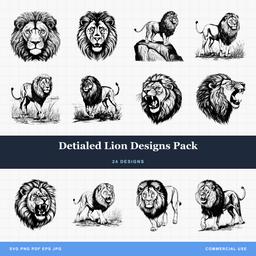 Detialed Lion Designs Pack24 designs, commercial license included$3.99
Customers ask for both without knowing there is a difference. A 24 inch cut-out silhouette for above a bed and a detailed portrait plaque are two genuinely different files of the same animal.
Tigers: a hundred holes in one shape
A tiger file can represent stripes as filled marks, separate color layers or openings in a body silhouette. Black on screen does not universally mean a hole. Inspect the fills, contours and intended retained material before assigning cut operations.
In a cut-through interpretation, the chosen stripe regions become openings in the panel, which is often exactly the effect you want: a tiger cut through dark walnut and mounted a half inch off a pale wall turns every stripe into a bar of wall colour. We covered the same principle on zebras and other big statement animals, where the stripe count is low enough to check by eye.
A tiger is where the count stops being checkable. Published counts put a real tiger somewhere near a hundred stripes, and a good design keeps enough of them to stay recognisable. Two things multiply with that count.
The first is severing. Stripes wrap around the body from both sides and taper as they go, and where a stripe from the back and a stripe from the belly nearly meet, the material between them becomes a narrow neck. One narrow neck is easy to spot. Twenty of them across a flank is where a panel quietly fails at its thinnest point, usually while you are carrying it.
The second is the face, where the markings are finer than the body stripes and are the first thing to close up or tear at smaller sizes. A design that cuts cleanly at 24 inches can turn the muzzle to mush at 10.
For a tiger the honest recommendation is to engrave unless the piece is genuinely large. Detailed Tiger Designs is drawn for that, with full stripe patterning and facial detail. Low Detail Tiger Designs keeps the stripes but stops them short of the outline in places, leaving a continuous spine of material, which is the structure a cut-through piece needs.
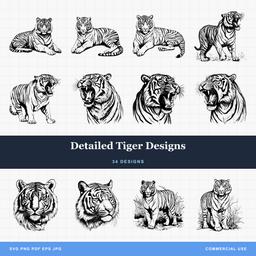 Detailed Tiger Designs34 designs, commercial license included$3.99
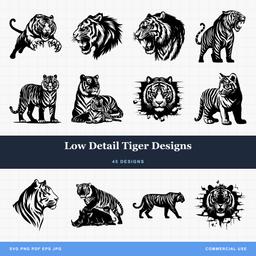 Low Detail Tiger Designs45 designs, commercial license included$3.99
Jaguars: the nesting problem nobody warns you about
Spots are worse than stripes, and rosettes are worse than spots.
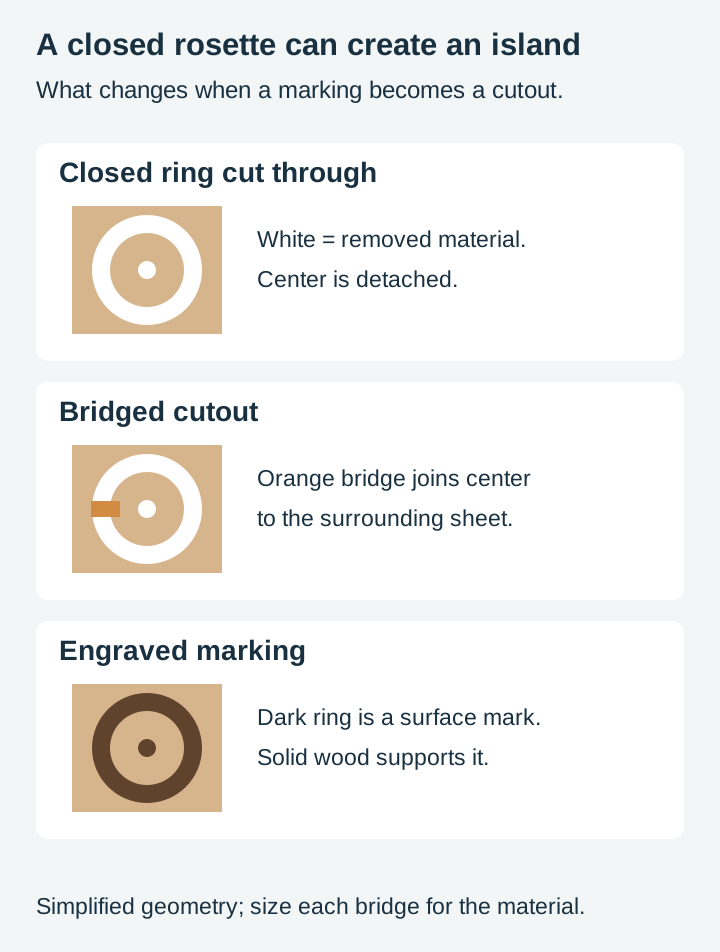
Picture the geometry. The body is a filled shape. Inside it, a rosette ring is a hole. Inside that ring, the paler centre is filled body again, which means it is an island of material touching nothing. And on a jaguar, that centre usually contains one or two small spots, which are holes inside the island.
Three levels of nesting, and the middle level floats. That outcome belongs to this closed-ring cutout construction. Painted markings, open rings and surface engraving do not require the same floating center. Cut a jaguar with closed rosettes and you get a body outline plus several dozen small discs on the machine bed, along with a coat that now looks like it was hit by a shotgun.
There are three ways out.
Bridge every rosette. Leave a narrow strip of uncut material joining each island to the surrounding body, exactly as you would with the middle of a letter O. The technique is the same one in our guide to stencil bridges, and the same rule applies: size bridges for each retained region and material, and place them consistently where the geometry allows.
Use open rosettes. A rosette drawn as a broken ring, with one side left open, has no island at all. The centre stays connected to the body through the gap. This is closer to how a leopard's markings actually look, and it is the version we draw when a design is meant to be cut.
Engrave instead. Engraving does not care about any of this. Filled regions burn, holes stay bare, and nothing can fall out of a panel you never cut through. On a jaguar this is usually the better artistic call anyway, since the whole appeal of the animal is the pattern and burning it keeps the coat as a coat.
One more thing worth checking if you edit the file yourself: the fill rule. A compound path filled with the nonzero winding rule cares about the direction each contour is drawn in, so a rosette whose inner contour runs the same direction as its outer one fills solid and the hole disappears on screen. Switch the path to even-odd and it comes back. Nothing is wrong with the geometry when this happens, only with which rule is interpreting it.
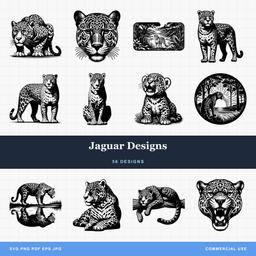 Jaguar Designs56 designs, commercial license included$3.99
Cougars: the easy one
After all that, a cougar is a break. No stripes, no rosettes, nothing nested. The animal is a shape and a pose, and everything expressive about it lives in the outline: the low crouch, the long tail, the shoulders bunched before a leap.
That makes the Cougar Designs Pack the one to reach for when the process is fussy. Pick a simplified pose and check it at the finished size. A long tail, narrow ankle or internal detail can still need support or a different process.
Mountain lions also carry a regional audience that the African cats do not. Anyone decorating a place in Colorado, Montana or British Columbia would rather have the cat that actually lives outside than one from a documentary.
Carving one instead of cutting it
A router changes the question completely. Instead of a shape cut from a sheet you get real depth in the surface, and for big cats that is a different product: the mane and the brow ridge are raised rather than implied.
Big Cat Relief Medallions contains shaded two-dimensional artwork, not a ready-made height model. For a sculpted surface, build or obtain a relief model and generate toolpaths in compatible CAM software. The medallion format guide explains what these packs include. If you have not run a depth map before, what a depth map actually is explains the format before you tie up the machine for two hours.
Where big cats actually sell
Two audiences, and they buy for different reasons.
The first is decor: home offices, gyms, home bars and teenagers' rooms. A big cat sells to the person who wants one strong piece rather than a gallery wall of small ones.
The second is team spirit. Lions, tigers, jaguars and cougars are among the most common school and club mascots around, which means a plain, non-trademarked big cat design has a buyer in nearly every town. Add your own lettering, keep clear of anyone's logo, and it becomes locker room signs, banquet awards and coach gifts. The Tribal Big Cat Designs pack suits that especially well, since the angular style already looks like an emblem.
Every pack in the Big Cats collection is $3.99, ships as SVG, PNG, JPG, PDF and EPS, and includes a commercial license, so the pieces you sell from it are yours to sell. Print-on-demand is allowed too, which matters here: a tiger that is a nightmare to cut is a perfect t-shirt.
Start with the cougar if you want the safest first cut, or the detailed lion if you have a big walnut panel and a laser you trust.
Designs for this project
Detialed Lion Designs Pack24 designs, commercial license included$3.99Detailed Tiger Designs34 designs, commercial license included$3.99Jaguar Designs56 designs, commercial license included$3.99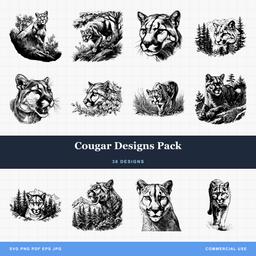 Cougar Designs Pack38 designs, commercial license included$3.99
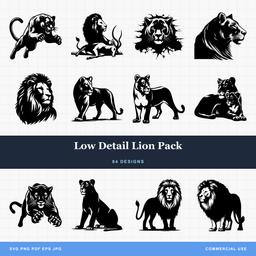 Low Detail Lion Pack84 designs, commercial license included$3.99Low Detail Tiger Designs45 designs, commercial license included$3.99
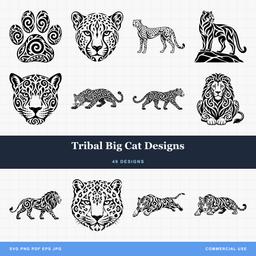 Tribal Big Cat Designs49 designs, commercial license included$3.99
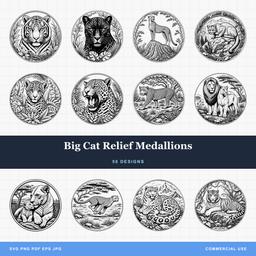 Big Cat Relief Medallions50 designs, commercial license included$3.99
Frequently Asked Questions
Why do the spots fall out when I cut a jaguar design?
That can happen when a cut-through interpretation makes the rosette a closed opening. A jaguar rosette makes this worse than a plain spot: the ring is a hole, and the paler centre inside the ring is a separate island of material with nothing joining it to the body. Cut it and that island drops through the grate. Either add a bridge to each one, pick a design where the rosettes are open on one side, or engrave the design instead of cutting it.
What is the difference between a jaguar design and a leopard design?
The markings. A leopard's rosettes are broken rings with an empty centre. A jaguar's rosettes are larger, more angular, and usually carry one or more small spots inside the ring. Jaguars are also heavier through the head and jaw, so a jaguar silhouette reads as blockier and holds up better at large sizes.
Which big cat design is easiest to cut from vinyl?
A simplified adult cougar silhouette can be a good starting point because it does not need stripes or rosettes. Still inspect the tail, paws and any interior detail; not every cougar file is a simple silhouette. Lions come next if you choose a low detail version. Tigers and jaguars are the hardest, since every stripe and every rosette is a separate weeding job.