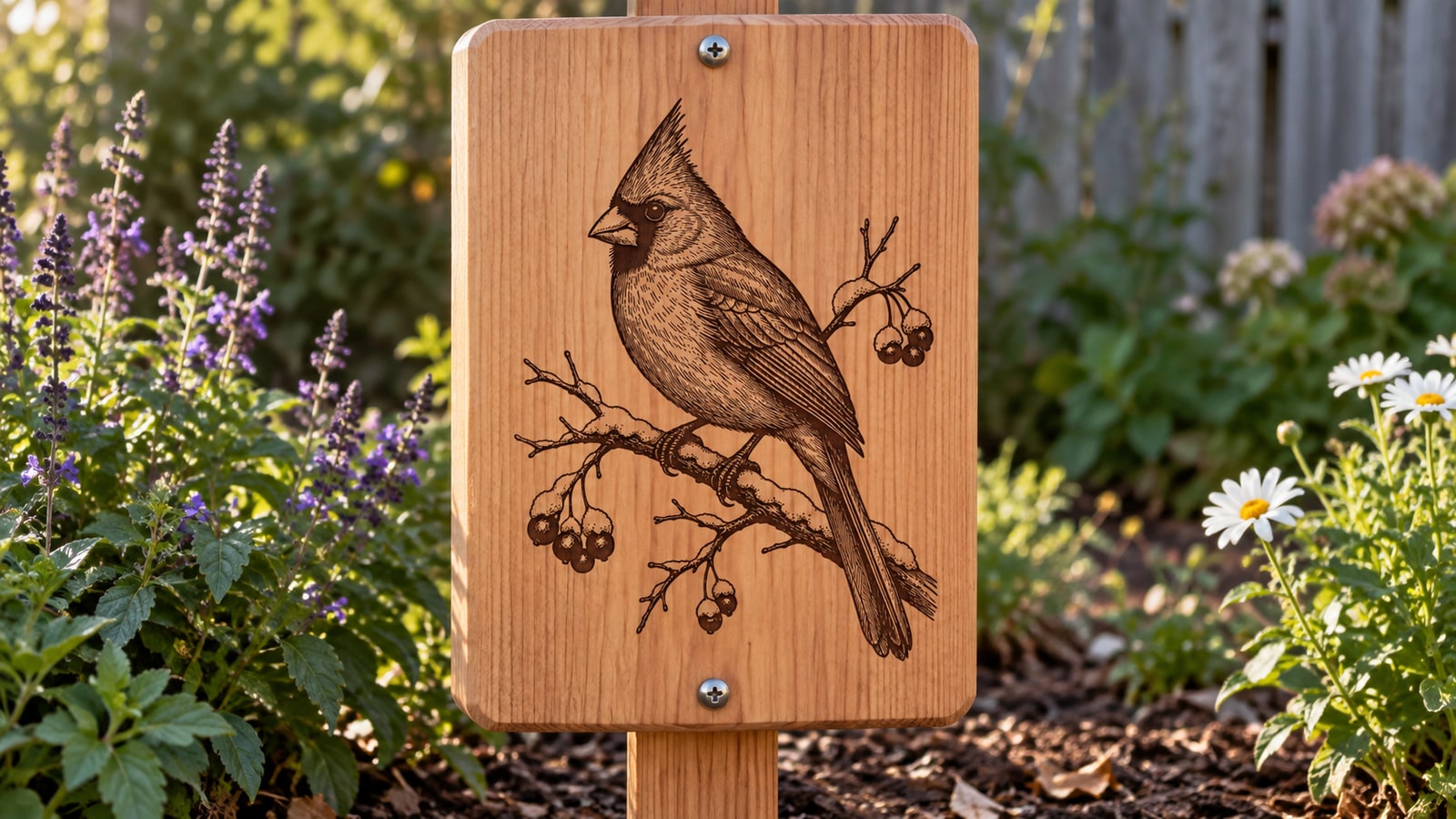
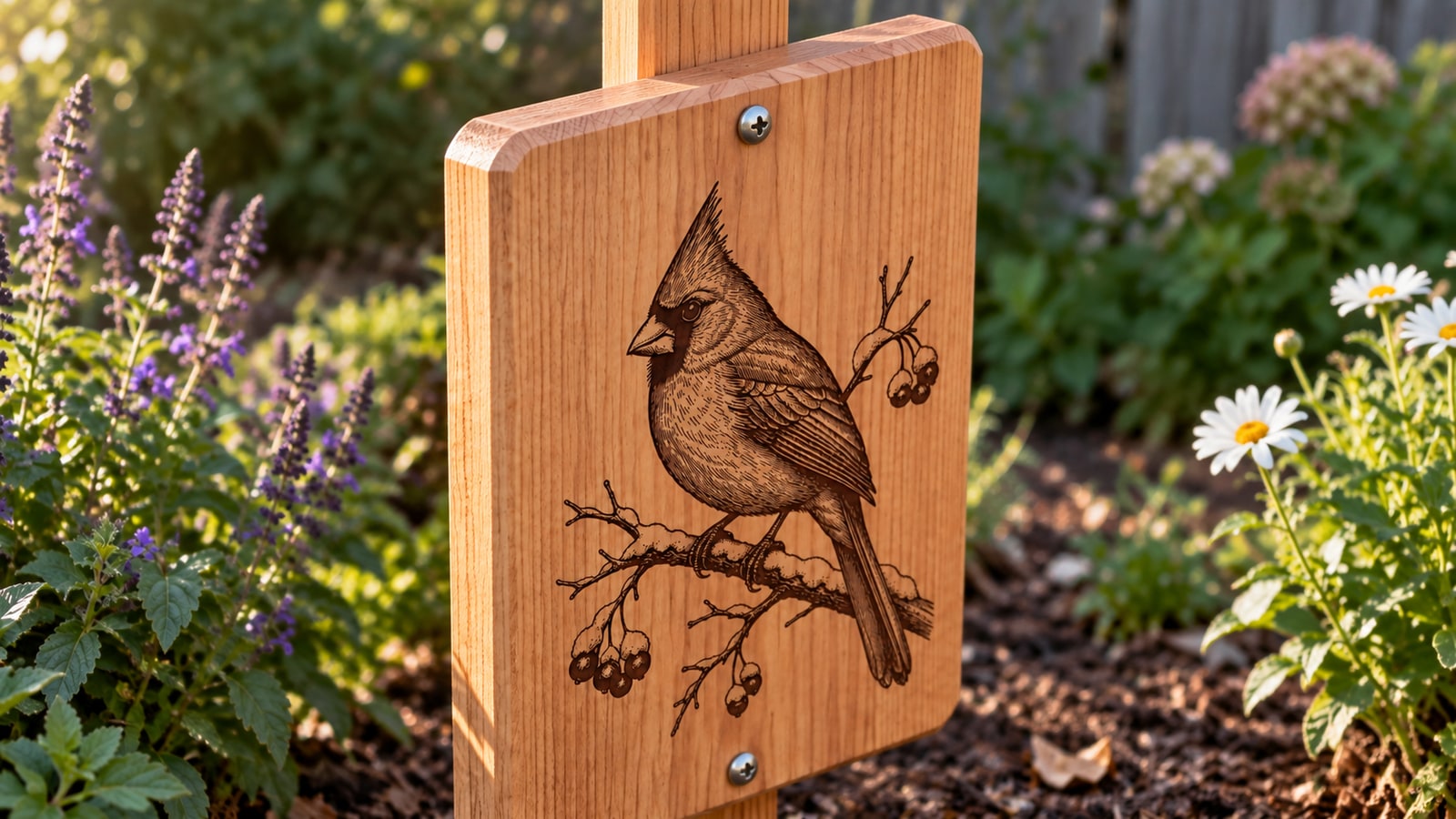
There is a specific kind of disappointment that comes from walking past your own garden sign in September. In April it was a crisp engraved cardinal on a cedar board, and now it is a grey plank with a faint smudge on it. The design did not fail. The finish did, and the detail was probably too fine to survive a summer in the first place.
Bird designs are one of the best-selling subjects in outdoor decor, and they are also one of the easiest to get wrong, because almost every tutorial you find was written for a piece that will spend its life on a wall inside a heated house. Outdoors is a different engineering problem. Here is what actually changes.
Tip
Short answer: for anything living outside, choose material rated for the exposure, use artwork that reads at viewing distance, and mount signs so water can drain. Finish all sign faces as the coating manufacturer directs. Feeders and nest boxes need their own construction and finish guidance; do not treat them like decorative plaques.
What a Season Outdoors Actually Does
Three forces work on a garden piece, and they attack different parts of it.
UV bleaches the background. An engraved design reads because scorched wood is darker than unscorched wood. Sunlight fades the unscorched surface toward grey, so the contrast that made the bird visible narrows month by month. The engraving is still there. It just stops standing out.
Moisture cycles raise the grain. Wood swells when it rains and shrinks when it dries, and every cycle lifts fibers slightly. On a fine engraved line, that lifting rounds the crisp edge into a fuzzy one. This is the mechanism behind "my hummingbird turned into a moth."
Freeze and thaw finds the glue. Layered plywood is a stack of thin veneers held with adhesive. Interior-grade adhesive lets go once water gets between plies and freezes, and then the top veneer peels like a sunburn.
None of that is a reason to avoid outdoor work. It is a reason to choose materials and design detail for the job.
Wood That Earns Its Place Outside
The USDA Forest Products Laboratory Wood Handbook groups heartwoods by decay resistance, and the resistant list is short and useful: western red cedar, redwood, black locust, and white oak. Those species contain extractives that make them unappealing to the fungi that rot wood. Note that this applies to heartwood, not the pale sapwood at the outside of the log, which has little natural resistance in any species.
Cedar is the practical everyday choice. It is soft, it engraves at low power, it smells wonderful, and it costs a fraction of what a hardwood does. Its downside is that softness: cedar dents if you sneeze on it, so it is better for signs than for anything handled daily.
White oak is the upgrade. It is dense enough to hold a sharp engraved edge, its closed pores resist water uptake, and it takes an exterior finish beautifully. It is also slow to engrave and hard on router bits.
Exterior-grade plywood exists and works, but the face veneer is usually a plain softwood that engraves unevenly and some face veneers mark unevenly because earlywood and latewood respond differently. Check the face quality, glue system and laser suitability of the exact panel.
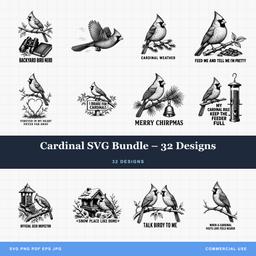 Cardinal SVG Bundle – 32 Designs32 designs, commercial license included$3.99
Feeders, and What the Design Should Be Doing
A bird feeder is a small building. It has a roof that sheds water, walls, and a floor that has to drain. The design work sits on the side panels and the roof gables, and the constraint nobody mentions is that the engraved face will be looked at from ten feet away, through a kitchen window, in flat light.
That distance is the whole sizing argument. A 32-design cardinal set includes both fine detailed birds and bold silhouettes, and for a feeder gable at roughly 5 by 4 inches, the silhouette wins every time. Fine feather linework at that size vanishes at viewing distance even when the piece is brand new.
For the build itself, glue matters more than most people expect. Titebond III is rated ANSI/HPVA Type I water resistant per the manufacturer's published specification, and is one option for exterior joinery. Follow its application requirements and pair adhesive with sound joints; the rating does not establish a lifespan for an entire feeder.
A few feeder variations worth building:
- Pitched roof hopper feeder with an engraved gable on each end. Cedar, roughly 8 inches wide, seed poured through a removable roof panel.
- Suet cage surround, a simple cedar frame with a cut silhouette panel on the front. Fast to produce, sells well as a small gift.
- Platform feeder with a cut-through border. Skip the interior engraving and use a pierced silhouette of birds along the rail so the shape reads against the sky.
- Window feeder back panel in clear acrylic with the design engraved on the reverse face so the bird sees a smooth surface. Acrylic engraves as a frosted white line and holds detail far better than wood outdoors, since it has no grain to raise. Our acrylic guide covers the settings and edge-finishing side.
Garden Signs, Stakes, and Plaques
Signs are the higher-margin half of this category, and they are where the personalization money lives. A family name plus a cardinal is a completely different product from a cardinal.
Cardinals in particular carry meaning for a lot of buyers as a memorial motif, and memorial garden stakes are one of the most consistently requested custom pieces in outdoor decor. Treat the copy respectfully and let the bird carry the emotion rather than crowding the board with text.
Owls suit a different buyer. They read as bookish and slightly gothic, which makes them a natural for gate signs, potting shed doors, and anything with a "keeper of the garden" feel. The 55-design owl set gives you enough poses to build a whole line rather than repeating one bird.
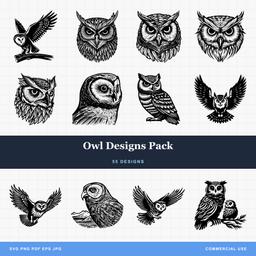 Owl Designs Pack55 designs, commercial license included$3.99
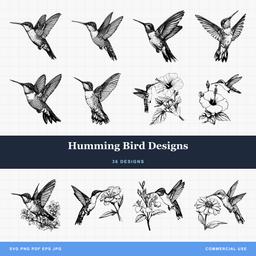 Humming Bird Designs36 designs, commercial license included$3.99
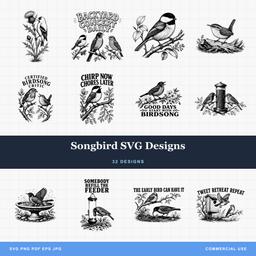 Songbird SVG Designs32 designs, commercial license included$3.99
Hummingbirds are the trickiest of the three and worth understanding before you cut. The appeal of a hummingbird design is the wing blur and the fine tail feathers, which is exactly the detail that weathering erases first. The fix is scale. A larger or bolder hummingbird is easier to read as contrast changes. No artwork size guarantees a particular lifespan outdoors. If a customer wants small, put the hummingbird on slate instead.
Material Pairings, and Why Each One Wins
| Material | Best bird project | Why it works outside | Watch out for |
|---|---|---|---|
| Cedar or redwood | Feeders, stakes, fence signs | Naturally decay resistant heartwood, cheap, easy to engrave | Soft surface dents; needs UV protection to keep contrast |
| White oak | Address plaques, gate signs | Dense, holds a crisp engraved edge, resists water uptake | Slow to engrave, hard on bits |
| Slate | Coasters, garden markers, small plaques | Choose stock suitable for outdoor exposure | Etch is pale grey on dark stone, so choose designs with mass |
| Cast acrylic | Window feeders, hanging suncatchers | No grain to raise, frosted engrave stays crisp | Check the exact stock’s UV and outdoor rating |
| Outdoor vinyl on metal | Mailbox and planter decals | Cheap, replaceable, sharp edges | Needs a smooth substrate; lifts on textured surfaces |
| HTV on garden flag fabric | Seasonal yard flags | Fast to produce, fabric hides imperfection | Fades faster than any other option on this list |
Slate avoids wood-grain swelling, but thin pieces can chip or split, and outdoor suitability still depends on the stone and installation. The catch is the visual one: a laser etch on slate is a pale grey mark on a dark surface, the inverse of wood, so designs built around delicate outlines nearly disappear. Pick birds with solid body mass. Our slate engraving guide goes deeper on prep and the oiling trick that brings the contrast back.
Sealing Decorative Signs
The following advice concerns decorative signs. For bird housing, Cornell NestWatch recommends untreated, unpainted wood and gives separate guidance on exterior painting. Keep feeder seed-contact areas untreated unless a finish is explicitly suitable for that use.
- Seal every surface, including the back and all four edges. End grain drinks water fastest, and an unsealed back is an open door for moisture that then pushes the finish off the front.
- Use a finish with UV blockers. Exterior spar urethane and marine varnish are formulated with them specifically to slow the fading that kills engraved contrast. Interior polyurethane has no such protection.
- Apply the finish after engraving. Only laser a prefinished surface when its exact coating is confirmed compatible with that process.
- Use stainless or brass hardware. Ordinary steel screws bleed black streaks down a cedar board within one wet season, and cedar's own extractives accelerate that reaction.
- Hang it so water leaves. A sign with a flat top edge holds a puddle. A sloping top or small overhang helps shed water.
Plan on refreshing the finish annually on anything in full sun. Tell your customers that too, because a piece that gets recoated once a year outlasts one that does not by a wide margin, and the advice makes you look like someone who knows what they are selling.
Carved Depth for the Premium Piece
If you have a CNC router, birds of prey are the subject that most rewards real relief carving. A hawk carved with actual depth catches shadow differently through the day, which no laser scorch can imitate. Our relief medallion designs are built as depth maps for exactly this, and paired with white oak they make the kind of piece that anchors a booth table and prices accordingly. The v-carving walkthrough covers the toolpath side.
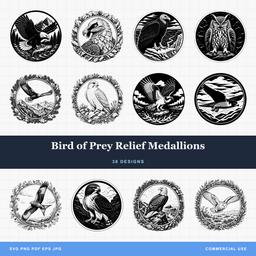 Bird of Prey Relief Medallions38 designs, commercial license included$3.99
Where to Start
If you are building one thing this weekend, make a cedar garden plaque with a bold cardinal, exterior-rated fasteners and a finish suitable for the exposure. If you choose a feeder instead, use a proven feeder plan and leave seed-contact surfaces untreated. Allow time for assembly, curing, drainage and cleaning access.
Every one of our bird packs is $3.99 with a commercial license included, so the feeder you build to learn on can also be the first of thirty you sell. Browse the full birds category for the other 21 packs, and take a look at wildlife designs for rustic decor if you want to build a whole outdoor line rather than one piece.
Designs for this project
Cardinal SVG Bundle – 32 Designs32 designs, commercial license included$3.99Owl Designs Pack55 designs, commercial license included$3.99Humming Bird Designs36 designs, commercial license included$3.99Songbird SVG Designs32 designs, commercial license included$3.99Bird of Prey Relief Medallions38 designs, commercial license included$3.99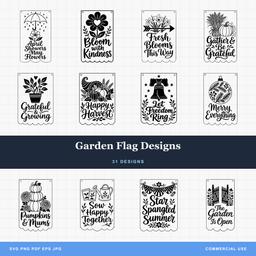 Garden Flag Designs31 designs, commercial license included$3.99
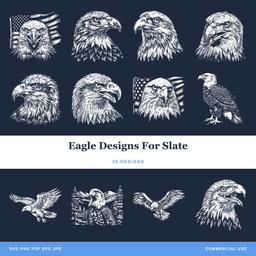 Eagle Designs For Slate30 designs, commercial license included$3.99
Frequently Asked Questions
What wood should I use for an outdoor bird feeder or garden sign?
Cedar, redwood, and white oak heartwood are the practical choices. The USDA Forest Products Laboratory Wood Handbook classifies those heartwoods as resistant to decay, which makes them useful outdoor candidates. Natural durability is not a guarantee in ground contact. For plywood, check the actual exterior bond and exposure rating; the name Baltic birch alone does not establish one.
Why does my engraved bird design look blurry after a season outside?
Two things happen at once. UV fades the surrounding wood so the contrast between scorched and unscorched areas drops, and moisture raises the grain so fine lines soften at the edges. The finest, lowest-contrast detail is often the first to become hard to read. Outdoors, scale the design up or pick a bolder silhouette and save the fine feather hatching for pieces that live inside.