The mug looked fine on the shelf. Plain white ceramic, the right size, four dollars. You printed the design, taped the paper down tight, ran the press for the full three minutes, peeled the paper back, and the mug was still plain white ceramic.
A mug without a suitable receptive coating will not give a reliable sublimation print. If the blank is verified, check the ink, transfer orientation and press conditions too; its appearance alone cannot diagnose the failure.
Tip
Short answer: sublimation dye only bonds to polyester. A blank works if it is made of polyester (fabric) or carries a polymer coating (hard goods). Bare ceramic, glass, wood, metal and cotton do not take it. If a seller does not call the item a sublimation blank and publish a press time and temperature for it, assume it is not one.
One rule explains almost every failed first attempt
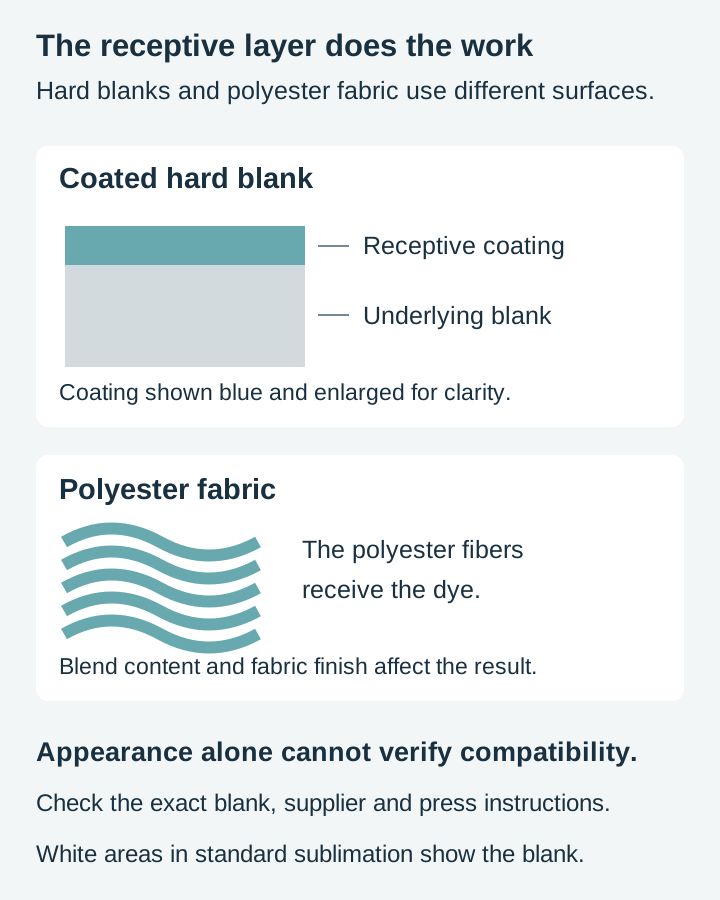
Under press heat, sublimation ink turns straight from solid to gas. That gas needs somewhere to go. Polyester's polymer structure opens up at pressing temperature, lets the dye in, then closes around it as the item cools, so the dye sits within the receptive material rather than forming a separate adhesive film. The coating or substrate can still scratch, chip or wear. It is not sitting on the surface. It is inside the material.
That means the real question about any blank is never "can it survive the heat". It is "is there polyester in there for the gas to enter". A supermarket mug's glaze is glass, not polyester. The dye vaporizes, finds nothing to bond with, and vents away into the press. You get a faint smell and a blank mug.
Our companion post on how sublimation actually works, and the workflow for pressing it, covers the printer, ink and paper side. This one is about the shopping, because that is where beginners lose money.
What takes a design and what does not
The pattern below is worth internalizing, because it holds for materials that are not on the list. If the item is not polyester and nobody coated it, it will not work.
| Blank | Takes a design? | Why |
|---|---|---|
| Ceramic mug sold as a sublimation blank | Yes | Carries a clear polymer coating over the glaze |
| Any mug from a supermarket or thrift shop | No | Glaze is not polyester and has no coating |
| 100% polyester shirt, white or light | Yes | The fibre itself is the receptor |
| 50/50 cotton-poly shirt | Partly | Only the polyester half holds dye, so the result is faded |
| 100% cotton shirt | No | Dye washes straight out |
| Stainless tumbler sold as a sublimation blank | Yes | Coated before it reaches you |
| Powder-coated tumbler not specified for sublimation | Do not assume | Coating chemistry and heat tolerance vary; verify the exact product |
| Coated aluminum photo panel | Yes | The coating is the whole product |
| Bare aluminum sheet | No | Nothing for the dye to enter |
| Sublimation hardboard or MDF blank | Yes | The white face is coated |
| Raw plywood or bare MDF | No | Wood does not accept sublimation dye |
| Glass sold as sublimation glass | Yes | Coated, usually on one face only |
| An ordinary drinking glass | No | Same problem as the mug |
Two entries there deserve a closer look, because they are the ones people argue about online.
Coated versus uncoated, and why you cannot see the difference
The receptive coating on a hard blank is thin and may sit over a white or clear finish. A coated mug and an uncoated mug of the same shape look identical on a shelf, weigh about the same in your hand, and ring the same when you tap them. There is no trick with a drop of water or a fingernail that reliably separates them.
So stop trying to inspect the blank and start reading the paperwork instead. A real sublimation blank comes from a manufacturer who has published press instructions for it, because the coating has a specific chemistry with a specific working window. ChromaLuxe, for example, publishes 385°F with a dwell of 1:30 to 1:35 and strong pressure for its small format aluminum photo panels. Unisub publishes per-product time and temperature sheets for its hardboard and ceramic lines. That document is the tell. A mug that came off a supermarket pallet has no such document and never will.
Brand names worth recognizing when you shop: ChromaLuxe and Unisub for hard goods, and Vapor Apparel for polyester garments. They are not the only good suppliers by any stretch, and plenty of unbranded blanks from established sublimation retailers are perfectly good. Verify the exact product and supplier listing even when a familiar manufacturer is named.
A related detail most beginners miss: the published numbers assume a normal room. ChromaLuxe's own pressing guidance states a humidity range of 40% to 60%, a room temperature of 65°F to 85°F, and notes that settings are calibrated for sea level, so higher altitudes may need less time. If your garage is humid in August and your results shift, the blank is not necessarily at fault.
About coating sprays
Sprays that add a sublimation-receptive coating to uncoated ceramic, glass, wood and cotton are a real product category with real manufacturers behind them, and those manufacturers claim durable results. We own no heat press and cannot tell you how any of them hold up over a hundred dishwasher cycles.
What we can say is that the economics rarely favor them for a beginner. A coated blank arrives ready, with a supplier's published settings and a predictable outcome. A sprayed thrift-shop mug adds a second variable to a process you have not yet made reliable, on an item that was never engineered to carry a coating near food or hot liquid. Try one for curiosity. Do not build a product line on it before you have made the ordinary path work.
Fabric: the polyester percentage question
Apparel is where the rule gets less binary and more annoying, because blends exist.
SanMar's decorator education is blunt about the threshold: "In a poly/cotton blend or tri-blend with less than 65% polyester, the dye will not bond to the cotton and will eventually wash out," producing dull colors and blurry images compared with 100% polyester. Vapor Apparel puts the same idea more simply in its sublimation FAQ: "Traditionally, you only sublimate on polyester-rich fabrics."
Here is what that means in the shop:
- 100% polyester. The brightest color and the most durable result. This is what you buy while you are learning, while still checking the garment’s finish and pressing instructions.
- 65% polyester or higher. The commonly quoted working floor. Color is softer than on 100% poly, and many sellers like that.
- 50/50 and tri-blends. They press, and they look good coming off the press, which is the trap. The dye in the cotton portion has nothing holding it, so the shirt fades noticeably in the wash. Fine as a deliberate vintage look. Not fine as a surprise for a paying customer.
- 100% cotton. Not a sublimation fabric. Do not spend the shirt.
That washing behavior is the single most expensive thing to learn late. A blend shirt that looks great in your photos and dull on the customer three weeks later costs you a refund and a review. If a customer wants a specific soft blend, price it knowing the finish will be muted from day one and say so in the listing.
There is no white ink
Sublimation dye is translucent, and there is no white in the ink set. Wherever your design is white, nothing prints and the blank shows through. Wherever your design is pale, the blank's color mixes in underneath.
Vapor Apparel states it directly: "Your ink colors need to be darker than the shirt color itself." So light blanks, and mostly white ones. A navy polyester shirt will happily take a black design that you then cannot see, which is a genuinely funny thing to do once and never again.
For dark garments, the answer is a different craft. Heat transfer vinyl on shirts puts opaque color on any fabric color, including cotton, and the same design files serve both workflows.
How to tell before you buy
Six checks, in the order that saves the most money:
- The listing calls it a sublimation blank, or says polymer coated, poly-coated, or sublimation ready. Wording like "perfect for crafters" is marketing, not a coating claim.
- There is a published time, temperature and pressure for that exact item, not a generic chart for the whole store.
- A manufacturer is named, or the retailer is a dedicated sublimation supplier rather than a general marketplace seller.
- Apparel states fibre content as a number. "Poly blend" is not a number. 65/35 is.
- The price makes sense. Coating is a manufacturing step and it costs something, so a coated blank is dearer than its uncoated twin. A suspiciously cheap bulk lot of "sublimation mugs" is worth one test order before you commit.
- Buy one before you buy fifty. Even a genuine blank from a new supplier deserves a single press before a hundred of them arrive on a pallet ahead of a craft fair.
What to buy first
If you are stocking a first order, work up in difficulty rather than buying one of everything.
Hardboard coasters and ornaments are the cheapest place to make mistakes. They press flat, they are small, and a ruined one costs pennies. They are also excellent sellers in sets of four, which makes practice stock into inventory.
Ceramic mugs are the classic next step. A mug press wraps the heating band right around the blank, so the pressure problem largely solves itself. The wrap area is generous enough for a full design and small enough to forgive a slightly wonky tape job.
Skinny tumblers look like mugs and are not. The full wrap is one continuous seam that shows every gap in your taping, and tumblers usually need a tumbler press or an oven method. Worth doing, worth doing third.
Photo panels produce the most striking result of anything on this list and punish you the most for a mistake, because the unit cost is real and the gloss surface shows every mark. Save them for when your press behaves predictably.
The design side, which is our end of this
Once the blank question is settled, the file question is easy, and this is the part we actually build.
Sublimation print software ultimately rasterizes the job and may accept several file types. The PNG in a design pack is a convenient starting point. Every PrintCutCarve pack ships PNG alongside the SVG for exactly this reason. When you need a bigger print, do not upscale the PNG. Open the SVG in free software, resize it there, and export a fresh PNG at the size the blank calls for. Vector art re-exports at any size without softening.
One advantage worth exploiting: sublimation can reproduce fine details that would be difficult to weed or retain as physical cutouts. A hairline flourish that would tear during weeding, or a gap too narrow to survive a laser cut, may print successfully if source resolution, coating and press conditions support it. Designs we build with delicate line work are frequently a better fit for a mug than for vinyl, which is the opposite of what beginners assume.
Saying-style designs are the natural fit for drinkware, because a mug is read at arm's length and a short line of text carries it. Our cat pack is 32 designs of exactly that shape, and it maps neatly onto mugs, coasters and tote bags for the cats audience, who buy this stuff constantly.
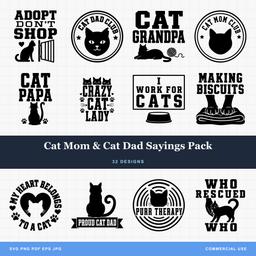 Cat Mom & Cat Dad Sayings Pack32 designs, commercial license included$3.99
For polyester apparel, affirmation and quote designs work well because they read at a distance and they sit comfortably on light garments, which is where sublimation is forced to live anyway. Our Positive Affirmation bundle runs 36 designs, enough to test which lines sell before you commit to a shirt order, and there are another eighty-odd packs in quotes and text if a customer wants something more specific.
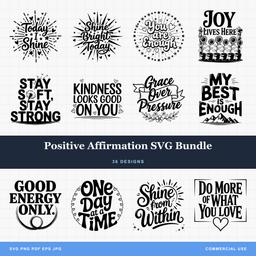 Positive Affirmation Svg Bundle36 designs, commercial license included$3.99Cat Mom & Cat Dad Sayings Pack32 designs, commercial license included$3.99
Every design is $3.99 and includes a commercial license, so the mugs, shirts and coasters you press are yours to sell with no unit cap. Print-on-demand is permitted too, which matters here: if you would rather not own a press at all, you can upload the same PNGs to a POD platform and let them handle the polyester. The restriction is on redistributing the file itself, not on the goods you make from it. If you are working out what to charge for the finished item, our pricing guide for handmade crafts walks through the math.
Buy one proper blank, press one design you already like, and see the paper come away with the color gone into the mug rather than sitting on it. That moment is why people put up with this hobby's shopping list. Browse the full design library and pick something worth pressing.
Designs for this project
Frequently Asked Questions
Why did my sublimation design not transfer to my mug at all?
An incompatible or missing receptive coating is one possible cause. Sublimation dye only bonds to polyester or to a polymer coating, and an ordinary glazed ceramic mug has neither. The dye turns to gas under the press and then has nothing to enter, so the mug comes out exactly as it went in. The wrong coating cannot be fixed with settings, but ink, transfer orientation and press conditions can cause failures on genuine blanks too.
What percentage of polyester do I need for sublimation on a shirt?
100% polyester gives the brightest and most durable result. SanMar's decorator education notes that in a poly/cotton blend or tri-blend with less than 65% polyester, the dye will not bond to the cotton and will eventually wash out, which is why 65% is the number most suppliers quote as a floor. Blends below that can still be pressed deliberately for a faded vintage look, but treat the softness as the point rather than an accident.
How can I tell if a blank is coated before I buy it?
You cannot tell by looking, because the coating is clear and thin. Judge the listing instead. A genuine blank is described as a sublimation blank or as polymer coated, names its manufacturer, and comes with a published press time, temperature and pressure for that exact item. A product page that only says the item is great for crafting is not making that claim.
Does sublimation coating spray work on uncoated items?
Coating sprays are sold specifically to make uncoated ceramic, glass, wood and cotton receptive to sublimation dye, and their manufacturers claim good results. We own no press and cannot verify how they hold up, so treat a spray as an experiment worth running on one item rather than the basis for a product you have promised to a customer. On anything that goes in a dishwasher or touches food, you are also adding a coating the item was never designed to carry.