Pricing is where craft businesses quietly die. Price too low and you are paying customers to take your work. Price too high with nothing behind the number and the table stays full at closing time. Most makers split the difference by copying whatever a similar item sells for, which means inheriting a stranger's costs, a stranger's speed, and quite possibly a stranger's mistake.
The fix is not confidence. It is arithmetic. This guide builds the full cost of a product from parts, walks three worked examples with real numbers, and then covers the psychology that decides how a correct price should look on a tag.
Tip
A starting calculation: Price = (Materials + Labor + Overhead) x 2. This is an example markup, not a universal pricing rule. Include selling and delivery costs, pay for your time, then check the margin and what customers will pay.
The four ingredients of a price
Every handmade product has four cost categories. Skip any one of them and the price underneath your pricing is wrong, no matter how carefully you do the rest.
Materials, per unit, including waste
Materials are everything physically in the sold item: the wood, vinyl, acrylic or slate, the paint and finish, the hardware, and the packaging it ships in. Packaging counts. The box, tissue, sticker, and thank-you card are part of the product cost, not a rounding error.
Calculate per unit, then add waste. If a $10 roll of vinyl yields 20 decals, the naive cost is $0.50 each. But you never use 100 percent of a roll: edges, weeding tears, and the one that cut off-registration all cost real money. Adding 15 percent for waste takes that decal to about $0.58, and that honest number is the one that belongs in your sheet.
Labor, at a rate you would accept from an employer
Time one unit from machine setup through cutting, weeding or sanding, finishing, and packaging. Then pick an hourly rate you would accept for skilled work. Somewhere in the $15 to $25 per hour range is a reasonable floor to start from, and specialized skills justify more.
The math is simple: a product that takes 15 minutes at $20 per hour carries $5.00 of labor. The discipline is refusing to zero it out when the final price looks high. If the price only works because your time is free, the business does not work.
Overhead, allocated per unit
Overhead is everything the business costs that no single product owns. It feels invisible until you write it down:
| Monthly overhead (example) | Amount |
|---|---|
| Machine depreciation ($3,000 laser over 5 years) | $50.00 |
| Software subscriptions | $10.00 |
| Electricity, blades, maintenance supplies | $15.00 |
| Design files (Platinum Club at $59.99/year) | $5.00 |
| Misc: listing fees, hosting, odds and ends | $4.00 |
| Total | $84.00 |
Divide by your monthly output. At 60 finished items a month, that is $1.40 per unit; call it $1.50 for comfort. Notice how cheap the design side is: at $3.99 per pack with unlimited production rights, or $5 a month for the whole library, design files are one of the smallest lines on the sheet. Guard the big lines instead.
Profit, which is not your wage
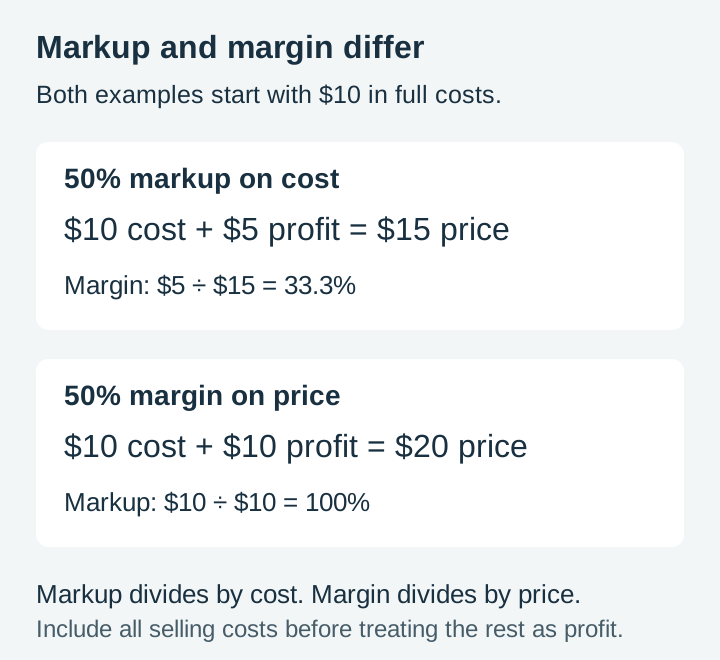
Profit is what remains after materials, labor, and overhead are all paid, including paying you. It funds new equipment, absorbs the slow months, and makes the business worth owning. Markup and margin use different denominators. Markup divides profit by cost; margin divides profit by selling price. A 1.5x cost multiplier is a 50% markup and a 33.3% margin before other fees. A 2x multiplier is a 100% markup and a 50% margin before other fees.
 Deer Designs For Slate30 designs, commercial license included$3.99
Worked example 1: engraved slate coaster set
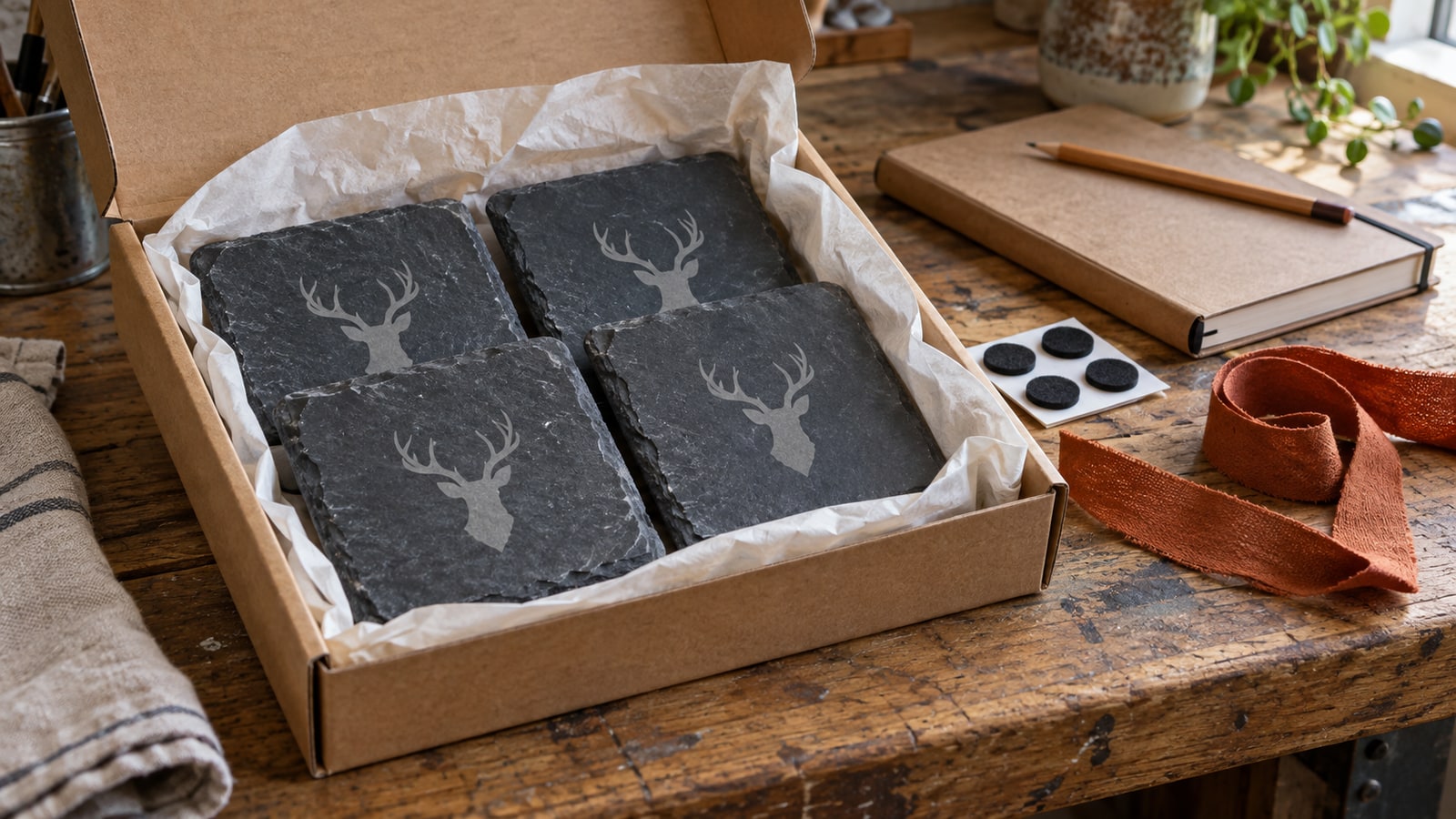
A set of four slate coasters, laser engraved with a wildlife scene, boxed as a gift set. Twenty minutes of total production time at $20 per hour.
| Cost category | Amount |
|---|---|
| 4 slate coasters (bought in bulk) | $4.00 |
| 4 felt backing pads | $0.40 |
| Packaging: box, tissue, ribbon | $1.50 |
| Labor: 20 min at $20/hr | $6.67 |
| Overhead allocation | $1.50 |
| Total cost | $14.07 |
| Price at 2x markup | $28.14, tag it $28 |
At $28 the set carries $6.67 of wages for you plus roughly $14 of gross profit before fees. Browse sold listings for comparable engraved coaster sets before committing, and if similar sets cluster well above or below $28, that is a signal to reread the market-adjustment section below, not to delete your labor line.
What Etsy fees do to that $28
Online fees come out of your price, so they belong in the math. Under Etsy’s fee policy and payment processing schedule checked on September 10, 2026, the main charges are a $0.20 listing fee, a 6.5 percent transaction fee on item price plus shipping, and payment processing that varies by country (around 3 percent plus $0.25 in the US). Etsy adjusts fees over time, so check the current schedule before you rely on these numbers.
Applied to a hypothetical $28 US order with one listing charge, no separately charged shipping and no sales tax in this simplified calculation:
| Fee (Etsy-published rates, check current) | Amount |
|---|---|
| Transaction fee: 6.5% of $28.00 | $1.82 |
| Payment processing: 3% + $0.25 | $1.09 |
| Listing fee | $0.20 |
| Total fees | $3.11 (about 11% of the price) |
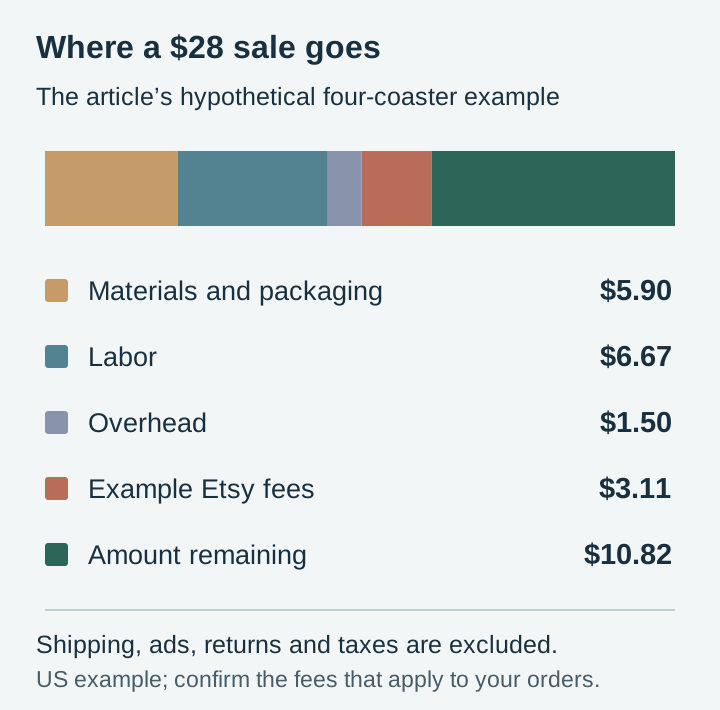
Net to you: $28.00 minus $3.11 is $24.89. Subtract the $14.07 cost and the example leaves $10.82 after the costs shown, with labor already included. Shipping, advertising, returns and taxes are not included here and would reduce that amount. Offsite Ads and other applicable fees can make the marketplace deduction higher, so use the charges that apply to your own orders.
Worked example 2: the $3 vinyl decal trap
Small vinyl decals look like pure profit because the material is nearly free. Run the numbers on one sold at $3 and watch the profit evaporate.
Costs per decal: vinyl at $0.58 (the waste-adjusted number from earlier), transfer tape $0.12, backing card and sleeve $0.20, so $0.90 in materials. Six minutes of weeding, taping, and carding at $20 per hour is $2.00 of labor. Overhead allocation, $0.40 for a small item. Total cost: $3.30. The $3 decal is underwater before fees.
And with fees? At a $3.00 price, Etsy's published rates take roughly $0.74 (transaction $0.20, processing $0.34, listing $0.20), leaving $2.26. After materials and overhead, $0.96 remains to pay six minutes of your time. That is $9.60 per hour, no profit, and no room for a single remake.
Price it from the formula instead: $3.30 cost times 2 is $6.60, so tag it $6.50 to $7.00, or sell decals in threes at $15 and let the bundle carry the fee load. Simple one-piece silhouette designs matter enormously here, because a decal that weeds in three minutes instead of six literally halves the largest cost line.
Worked example 3: the cutting board and the market adjustment
An engraved bamboo cutting board with a family name design. Materials: board at $6.50 in bulk, $0.30 of food-safe oil, $1.20 of packaging, so $8.00. Labor: 25 minutes at $20 per hour is $8.33. Overhead $1.50. Total cost: $17.83.
The formula says $17.83 times 2 is $35.66. Suppose comparable personalized boards in your market mostly sell in the twenties. You have three honest moves, and cutting your labor rate is not one of them:
- Attack the material cost. Restaurant supply stores sell bamboo boards in bulk; getting the board to $4.50 drops total cost to $15.83 and the 2x price to $31.66.
- Attack the labor. Batching five boards per engraving session amortizes setup, and a 15-minute effective time cuts labor to $5.00, total cost to $14.50, and the 2x price to $29.
- Justify the price. Personalization, gift packaging, and better photography move a board out of the commodity pile. Buyers pay more for the board with their family name and wedding date than for a generic one, and the file cost of offering that is zero once you own the design.
At a 1.5x multiplier, $17.83 becomes $26.745, or $26.75 rounded. That multiplier is not a break-even threshold: break-even depends on all costs, including fees and delivery. If the market will not support the margin you need, change the costs or the product rather than hiding your labor.
The two formulas, stated plainly
Simple formula: Price = (Materials + Labor + Overhead) x 2. The 2x multiplier is the traditional wholesale markup. It builds in profit and leaves room to wholesale at cost-plus if a shop ever wants to stock you.
Market-adjusted formula: Price = Total cost x a multiplier between 1.5 and 3, tuned to what comparable items actually sell for. Premium positioning, personalization, and scarcity push the multiplier up. The right multiplier depends on the product and channel; calculate the resulting margin after all costs rather than treating 1.5 as a universal floor.
Pricing psychology: how the right number should look
Once the arithmetic gives you a price, presentation decides how it lands.
- Charm endings online. $27.99 reads meaningfully cheaper than $28.00 on a screen. Use .99 or .95 endings for Etsy and your website.
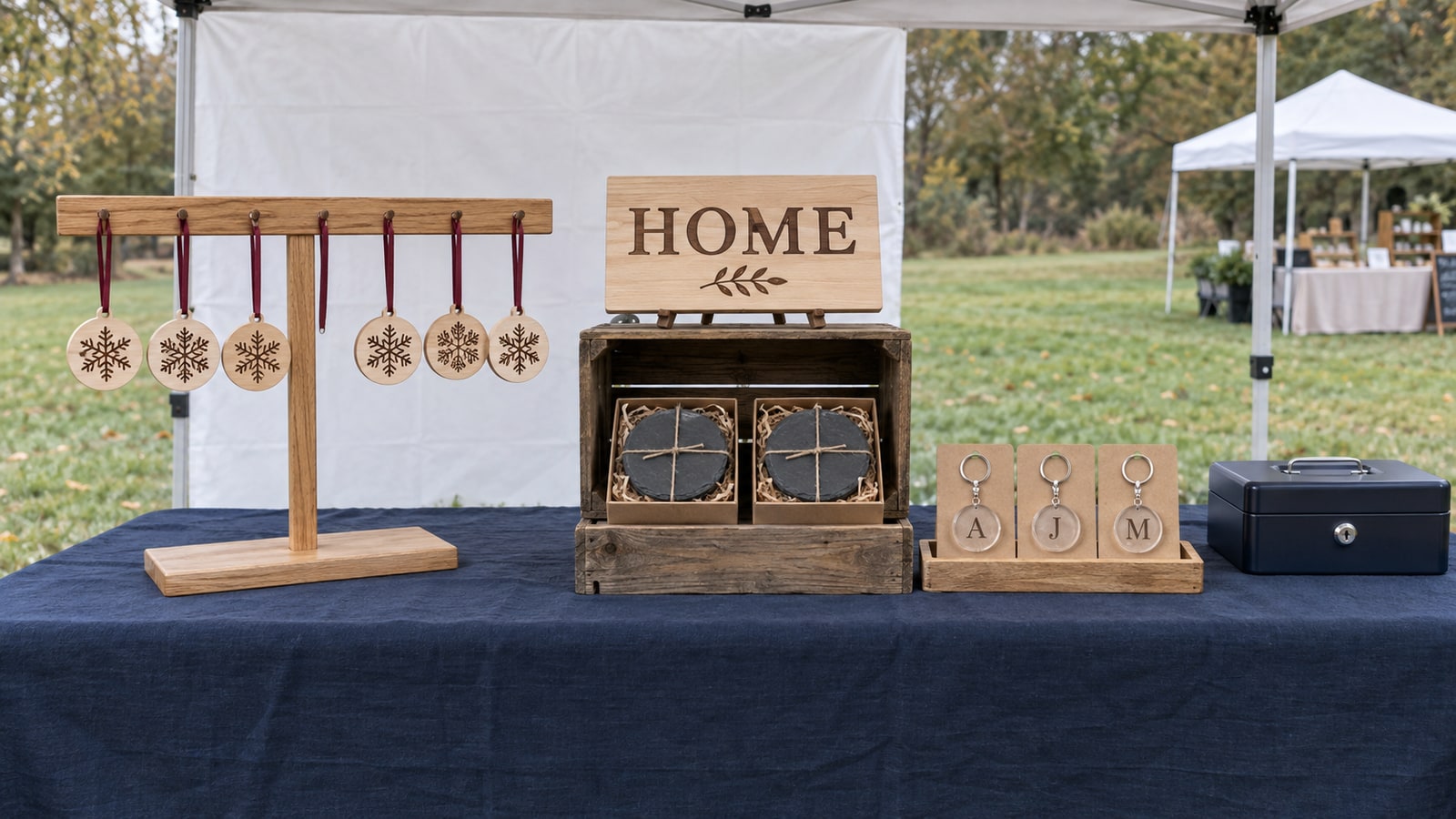
- Round numbers at craft fairs. Cash buyers prefer $25 and $30, and round numbers keep the line moving. Same math, different tag.
- Anchor high. Display your most expensive piece prominently. The $45 sign makes the $28 coaster set feel reasonable, and sometimes the anchor sells too.
- Bundle. Four coasters at $28 outsells single coasters at $8, even though the per-unit math barely differs. Sets also raise your average order, which spreads the fixed fees thinner.
- Free shipping, priced in. A $32 item shipping free tends to outsell a $25 item plus $7 shipping. The buyer pays the same either way; one of them just feels better.
A note on craft fair math
Selling in person swaps Etsy's percentage fees for fixed ones, and fixed fees need their own allocation line.
Say a weekend market charges a $75 booth fee and you realistically expect to sell 50 items. That is $1.50 of event overhead per unit, on top of your normal sheet. Add card processing on the sales that are not cash (a flat percentage per tap, as published by your card reader provider), plus fuel and the table decor you bought for the booth.
The practical move is to price identically online and in person. Fair prices that undercut your own Etsy shop train your best customers to wait for the market, and the fee structures roughly cancel out anyway: Etsy's percentages on one side, booth fees and your Saturday on the other.
The mistakes that keep sellers poor
Forgetting fees. Every marketplace takes its cut from the top line. Build roughly 10 percent into online prices from day one rather than discovering it in your first payout.
Working for free. The most common mistake and the most fatal. Your time is the most valuable input in the whole sheet, and it goes on the sheet.
Racing to the bottom. Someone will always sell cheaper, sometimes because their sheet is wrong. Compete on quality, personalization, and service. The buyer who leaves you over a dollar was never going to leave a review worth having.
Never repricing. Materials drift up, your speed improves, your reputation compounds. A price set once and never revisited is wrong in both directions within a year. Quarterly is often enough for the review to stay honest.
When to raise prices
Raise when the signals line up, and treat them as good news:
- Items sell out consistently and quickly; demand is outrunning supply
- Material costs have risen since you last priced
- You have added quality, personalization, or packaging worth paying for
- Your reviews and repeat-buyer count have clearly grown
- You are overwhelmed with orders and cannot keep up
That last one deserves a beat. Being buried in orders at a too-low price is not success, it is the market volunteering to pay you more. A 10 to 15 percent raise typically trims volume back to sanity while total profit goes up.
Keep the cost side boring
The cheapest line on every sheet in this guide is the design. A $3.99 pack with a commercial license included can supply an entire product line, and the Platinum Club puts the whole library under $5 a month on your overhead sheet. Cheap, predictable design costs mean your pricing energy goes where it matters: materials, speed, and positioning.
 Cutting Board Sayings Designs40 designs, commercial license included$3.99
 Dog Lover Silhouette Pack32 designs, commercial license included$3.99
Ready to put the sheet to work? Start with our guide to selling on Etsy, pick products from the best-selling craft items list, and squeeze the labor line with the batch production guide.
Designs for this project
Frequently Asked Questions
What is a good profit margin for handmade crafts?
There is no universal margin for every craft business. Include materials, paid time, overhead and selling costs, then calculate margin as profit divided by selling price. A 50% markup on cost produces a 33.3% margin before additional fees; a 2x price produces 50% before those fees.
Should I count my own labor when pricing handmade items?
Yes, always. Track how long one unit takes from setup through packaging, set an hourly rate you would accept for skilled work, and put that number in your cost sheet before any markup. If the price only works when your time is free, you have a hobby with expenses, not a business.
How often should I review my prices?
Put a quarterly review on the calendar, and reprice sooner when a trigger hits: material costs rise, you add personalization or better packaging, items sell out faster than you can make them, or your reviews and reputation have clearly grown. Selling out consistently is the market telling you the price is too low.